

We have all heard someone say that AK is a drawing hand, some say JJ is the most difficult hand to play in cash game poker, and some even say it’s AQ. AJ is also one of those poker hands that can look far stronger than it actually is. It contains an ace, has a respectable kicker, and can make a top pair with either card. On paper, that sounds like a very strong starting hand.
The problem is that AJ often creates exactly the kind of situations that can lead to winning small pots when you’re ahead and losing large pots when you’re behind.
This doesn’t mean AJ is a weak hand. Far from it. The important lesson is understanding when AJ is strong, when it is vulnerable, and how easily its apparent strength can become expensive in a deep-stacked cash game.
Why overplaying marginal hands might make recreational players feel the game is rigged
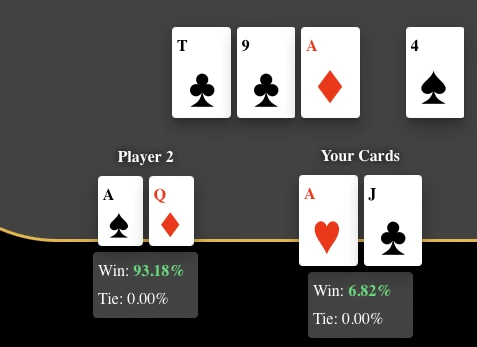
Overplaying your marginal hands, for example stacking off with top pair holding AJ 200bb deep in a single-raised pot, can result in thinking the deck is stacked against you if you play recreationally and don’t have good strategic fundamentals in place.
While that might be the case at some odd online poker rooms or casinos offering poker without proper security measures, almost every operator holding a known gambling license needs to make sure their rng’s are bulletproof and cheating doesn’t occur. And if it does, they aim to seize balances of any cheating accounts immediately to protect the playing environment. Some of the commonly used ones include Malta and Curacao licenses.
Source: onlinecasinogroups.com
Why AJ is easy to overplay
AJ is deceptive because pairing either of your hole cards can make your hand look extremely strong. If an ace comes on the flop, you have top pair with a good kicker. It is very easy to think I have the top pair with an Ace so I probably have the best hand with this kicker. If a Jack comes instead, you still have a top pair with a strong kicker, which can once again feel like a hand worth building a large pot around. The problem is that a top pair is not the same thing as a hand that wants to play for stacks; when you are ahead with AJ, your opponent may simply have a weaker pair, a draw, or a hand that cannot continue against significant pressure more often than not. This creates the classic poker dynamic of winning small pots when you are ahead and losing large pots when you are behind.
For example, if you hold AJ and the flop comes A72, you have a very strong one-pair hand. But based on the previous actions, your opponent can still have a top pair with a better kicker, two pairs and sets. Against all of these hands, you are already significantly behind. The deceptive nature of AJ becomes even more important because your opponent doesn’t need to have an obvious monster for you to be in trouble. A hand such as AQ can look almost identical to AJ from your perspective until the money starts going into the pot.
The same problem exists when you pair the Jack. Suppose you hold AJ and the flop comes J84. Again, you have a top pair with an Ace kicker, which is normally a very respectable hand, but continuing to build a huge pot can become dangerous when your opponent is showing significant strength. The only hands that you are winning a bit of a pot from based on the runout are KJ and QJ, as you are still behind sets and overpairs. This can once again create quite difficult situations for AJ.
How position and suits affect your strategy with AJ
AJ shouldn’t be viewed as exactly the same hand in every situation. Its value can change substantially depending on where the action comes from, your position at the table, and whether the hand is suited or offsuit.
Facing an early-position raise is one of the situations where the deceptive nature of AJ becomes particularly important. As early position opening ranges are much stronger than late position ones, when an opponent opens from early position and you continue with AJ, you can frequently find yourself playing against a range that can have you outkicked or have a strong pocket pair against which only you ace is live. This means that when an Ace flops, you aren’t automatically in a comfortable situation, and if the situation does favor you, you are not going to win a very big pot.
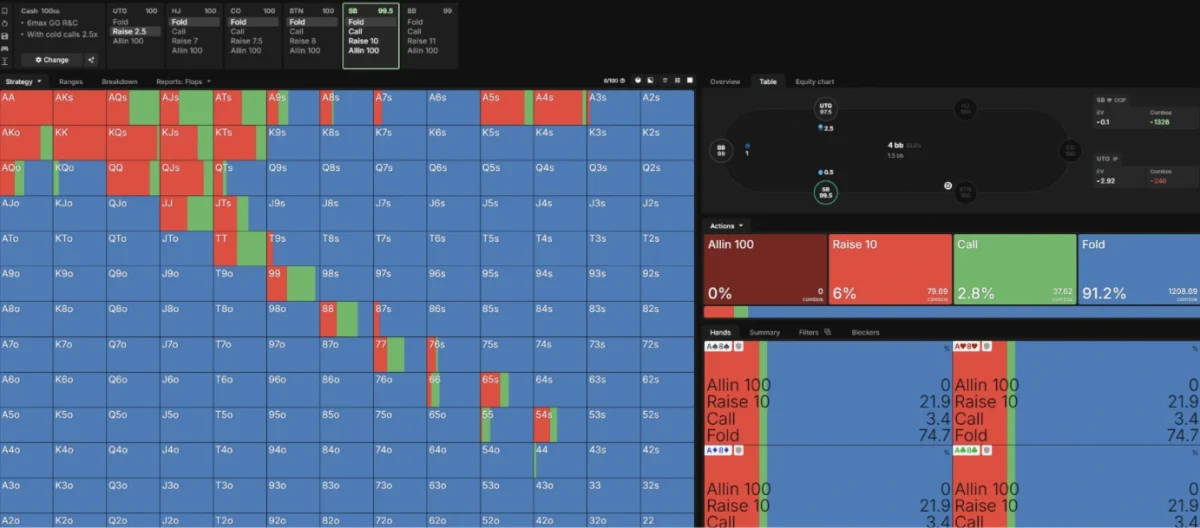
Here we have a simple cash game preflop solution when UTG has opened and it has folded to us on the small blind. As you can see, we are playing extremely tight to a point where we are straight up folding AJ preflop due to the fact that we are out of position for the remainder of the hand and the original raise has come from the strongest position possible.
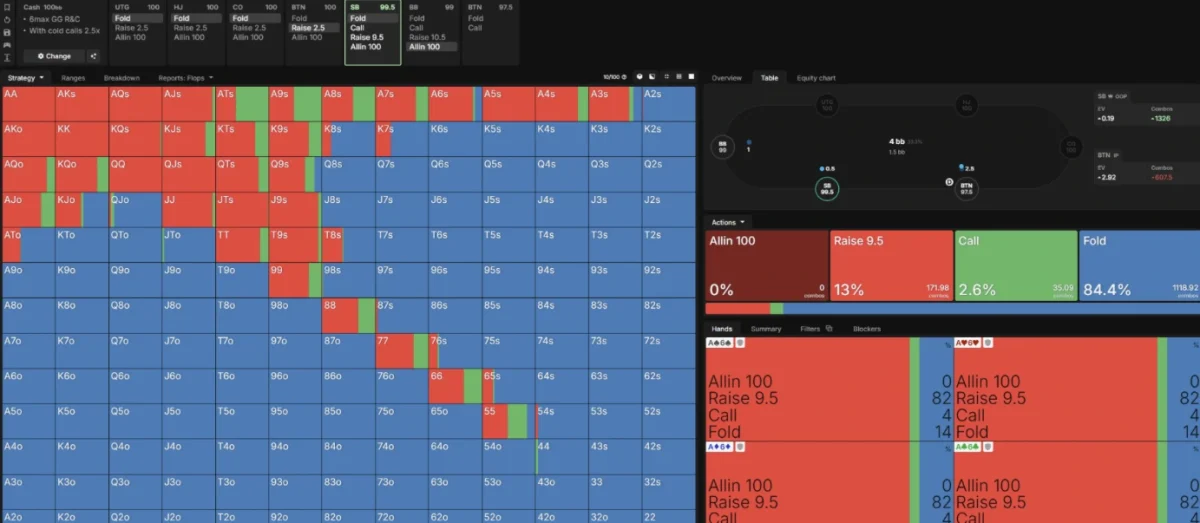
And in contrast here above, we have another scenario where the button is the first aggressor and we are always playing AJ. In fact, we are 3betting our hand the vast majority of the time, even though we are first to act & in the weakest position for the remainder of the hand. The aggression here is thanks to the fact that the button is raising so wide into only 2 players left to act. It displays the importance of position and relevance of our opponents’ range as mentioned before perfectly.
Pot size and effective stack holding AJ
One of the most important considerations when playing AJ is how large the pot is becoming relative to the effective stack. Top pair can be perfectly happy playing for a moderate pot. The same top pair hand can become extremely uncomfortable when the pot grows to several hundred big blinds; this is especially relevant in deep-stacked cash games. Imagine holding AJ on an ace-high flop and building a large pot through multiple streets. By the river, you may have invested a substantial amount of money with nothing more than one pair. If your opponent starts putting significant money into the pot, you can find yourself facing a very difficult decision. The danger is that the absolute strength of your hand hasn’t changed, but the amount of money you’re risking has increased dramatically.
Top Pair Doesn’t Automatically Want to play for stacks, but can be very comfortable playing for a small to medium-sized pot. This is an important concept to understand. A top pair can be a very strong hand in a small or medium-sized pot. With a hand like AJ, you should continuously ask yourself questions like What worse hands can realistically call me? What better hands can my opponent have? How strong is my opponent’s range? How deep are the effective stacks? What does my opponent’s line represent? These questions become increasingly important as the pot grows.
Why Deep Stacks Make This Even More Important
Deep-stack poker changes the value of different types of starting hands. When stacks are shallow, the ability to make one pair quickly can be very valuable; however, when stacks become deep, hands that can make extremely strong disguised hands can become increasingly attractive, such as suited connectors and small to medium pocket pairs, because you can hit a very strong hand without investing a significant part of your stack, but the implied odds when you do hit are enormous. Suited connectors can flop huge draws that can allow you to play more aggressively and give yourself a chance to win the pot more than one way. These hands can potentially win very large pots when they connect strongly, and when you do, the strength of your hand is often more disguised.
AJ Isn’t Bad—It Just Requires Discipline
The lesson isn’t to avoid AJ; it is a strong starting hand and can be highly profitable when played appropriately. The mistake is treating AJ as though it has the same value in every situation. You would do well to consider position, opponents’ range, effective stack size, the size of the pot, board texture, and betting action. AJ can be a strong value hand against a wide range from late position, but the same hand can become much more problematic against a strong early-position range. And while a top pair with AJ can often justify betting for value, it doesn’t automatically justify playing for stacks.
The Big Takeaway
AJ is dangerous precisely because it looks so good when it connects. Pairing the Ace gives you the top pair with a strong kicker. Pairing the Jack also gives you a top pair with a respectable kicker. Both situations can create the feeling that you have a hand strong enough to continue putting money into the pot. But against strong ranges, those same hands can be dominated or drawing very thin against stronger made hands. The result can be a classic poker problem: You win modest pots when your opponent has a weaker hand, and you lose much larger pots when your opponent has a stronger hand. Good cash game players therefore don’t simply ask how strong their hand is. They ask questions like: how strong is AJ relative to my opponent’s range, the board, the pot size, and the money behind. That distinction is what prevents a strong-looking hand from becoming an expensive one.