

A river card can make your hand look stronger while leaving you in a worse position than you were on the turn.
That happens when the board changes which five cards actually make your best hand. Poker players usually call it getting counterfeited. Two pair is the most common example, although paired boards can create the same problem with much stronger holdings.
The mistake is usually simple: you keep thinking about the hand you had one street ago instead of rebuilding it after the new card arrives.
Your Hole Cards Don’t Automatically Play
Texas Hold’em gives you seven available cards by the river, but only five of them form your final hand.
Under the standard best five-card hand rule, you can use both hole cards, one of them or neither. If the board improves, a card that previously helped your hand can suddenly become irrelevant.
That is where counterfeiting starts.
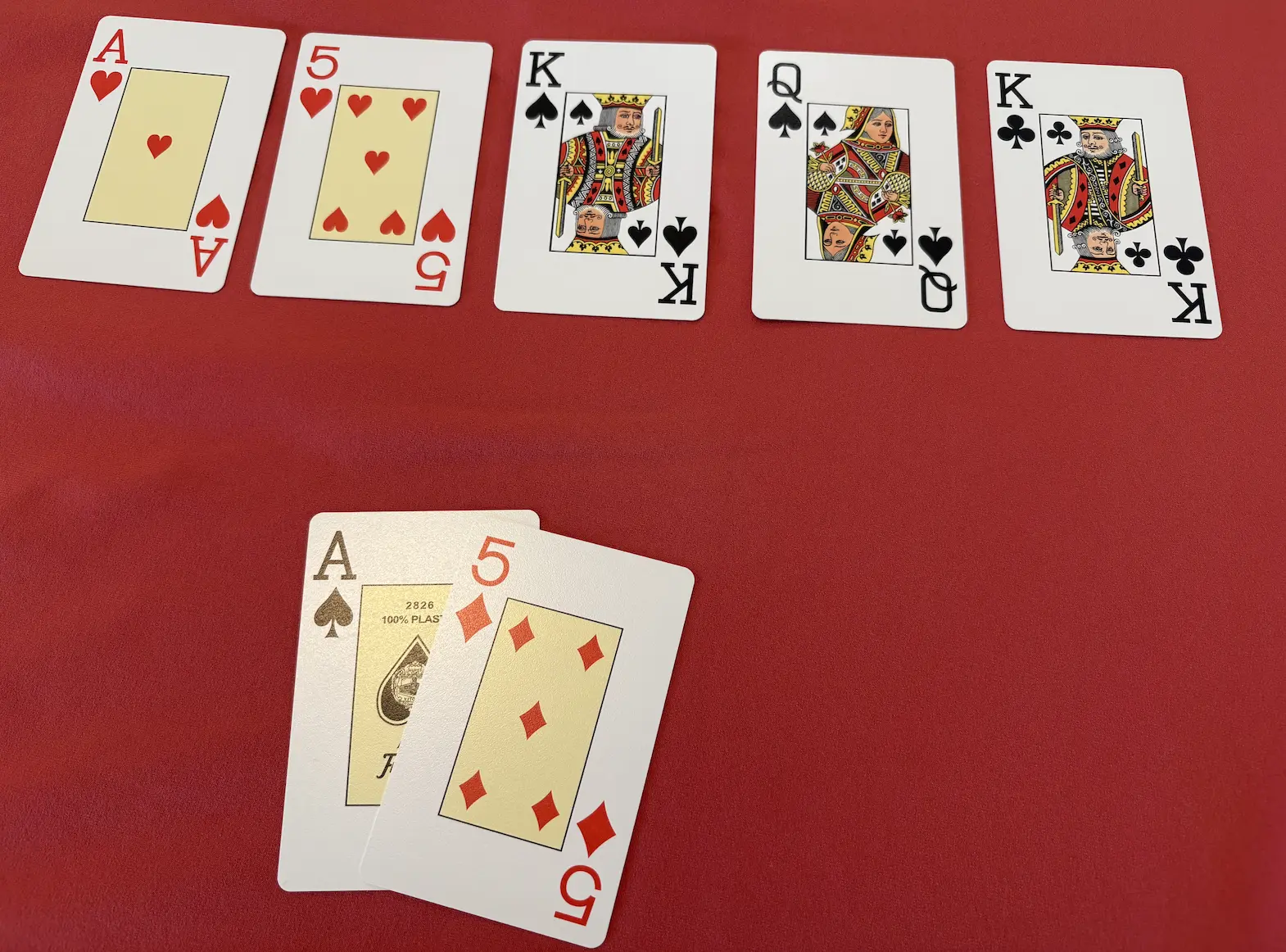
Say you hold A♠ 5♠ on this turn:
A♦ 5♣ 9♥ K♣
You have two pair, aces and fives.
Now the river is K♦.
Your final hand is no longer aces and fives. It is aces and kings with a nine kicker:
A A K K 9
The five in your hand no longer plays.
Two Pair Is the Classic Trap
Counterfeiting hurts because opponents often benefit from the same board card more than you do.
Imagine your opponent in the previous example holds A♣ Q♣. On the turn, your two pair is comfortably ahead of their single pair of aces.
Once the second king arrives, both players have aces and kings.
Your opponent’s queen now plays as the kicker:
Opponent: A A K K Q
You: A A K K 9
A river that apparently gave both players another pair actually erased the advantage created by your five.
This is why saying “I have two pair” isn’t enough often in the showdown when the board has paired. In that case you need a kicker that actually plays.
Full Houses Can Be Counterfeited Too
The same idea can appear higher in the rankings.
Suppose you hold 7♠ 7♦ on:
Q♥ Q♣ 7♣ 2♠
You currently have sevens full of queens. An opponent holding 9♠ 9♦ has only two pair at this stage and is well behind.
Now the river comes Q♦.
The basic ranking rule for a full house in poker is to compare the three-of-a-kind first and then the pair. After that river, both players use the three queens on the board.
Your hand becomes:
Q Q Q 7 7
The opponent now has:
Q Q Q 9 9
Pocket nines went from being behind to making the higher full house.
Nothing happened to your hole cards. The board changed how useful they were.
Stop Reading Your Hand Strength in Isolation
Correctly identifying your five cards is only the first step. You still have to ask which hands in your opponent’s range improved more than yours.
Our poker hand-reading guide recommends evaluating your own hand strength, the board and the range an opponent can reasonably hold.
Counterfeit cards make that process especially important.
If a river pairs the board, look at which pocket pairs now make stronger two-pair or full-house combinations. If your weaker pair disappears from the final five cards, check which kickers can now beat you.
The hand name alone can hide a lot of that information.
Two Pair Example: Follow One Hand Through the River
Consider one more Hold’em hand.
You hold:
8♠ 7♠
Flop: 8♦ 7♣ 2♥
You have two pair, eights and sevens.
An opponent with K♣ 8♣ has one pair. You’re well ahead.
Turn: A♣
Nothing changes your basic hand. You still have eights and sevens.
River: A♦
The board now reads:
8♦ 7♣ 2♥ A♣ A♦
Your best five cards are:
A A 8 8 7
Your pair of sevens has disappeared from the hand.
The opponent with K♣ 8♣ now has:
A A 8 8 K
The king kicker wins.
That river didn’t give the opponent trips, a straight or a flush. It simply made one of your original pairs useless.
Rebuild the Five Cards Every Street
When the board pairs on the turn or river, pause before acting.
Spell out the five cards that make your hand and then do the same for the strongest realistic hands your opponent can hold.
If one of your hole cards has stopped playing, your relative strength may have changed considerably even though the hand category on the screen still looks strong.
That quick recalculation prevents a common mistake which is paying off a river because you’re still thinking about the hand you had before the final card arrived.