
What Will I Learn?
What is Short Deck Poker
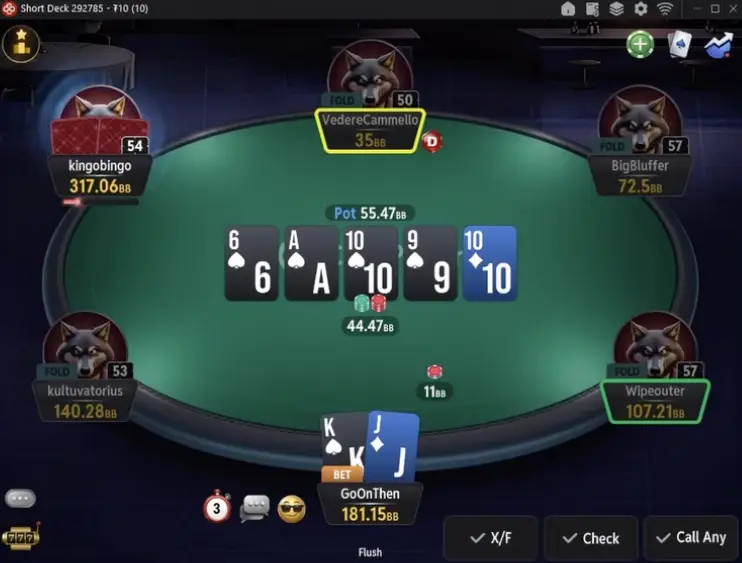
Short deck, also known as 6+, is a form of texas holdem with all cards below 6 removed from the deck. This means that instead of the traditional 52 card deck there are only 36. A shorter deck causes different strategic situations for an otherwise well-known game known worldwide. Let’s peek into what else is different and how it changes the game. Just like Texas Holdem you get 2 hole cards and 5 community cards, and try to win across 4 betting rounds.
The game was created in Macau and much like Pot-Limit Omaha became popular for its heavy action. Although traditional poker experience helps a ton, adjustments still remain essential for a profitable game.
Players need to rethink starting hands, drawing equity and betting decisions. Read on to see how:
Short Deck Rules: Betting structure & Hand Rankings
Pre-Flop
Short deck follows mostly traditional texas holdem betting rounds and structure. Before the cards are even dealt there is one difference – the blinds. In Short Deck, it is quite common to have antes instead of blinds. This means that every player antes before cards are dealt with an added additional ante from the button.
Once antes are in the middle and 2 hole cards dealt to each player, the action starts left from the button. Just like in regular hold’em you can either call/raise or fold. Since the game is no-limit there is no maximum aside from your entire stack.
Flop
After the initial betting round is complete, 3 community cards are dealt. Just like in normal Hold’em you can use these cards to combine a 5 card combination using either all or none of the cards from your hand. After the flop is dealt, another round of betting begins left from the button.
Turn
Once the flop betting round is done, the turn is dealt and another betting round begins. Again, the betting starts left from the button. Player(s) in position have an information advantage since they see what other players do first.
River
After the turn betting round finishes, the river is dealt. There is a final betting round, and if at least two players remain in the hand, a showdown. At the showdown, the strongest five-card combination wins the pot – but not so fast, the rankings have a small difference compared to Holdem!
Hand Rankings in Short Deck
Short Deck uses familiar five-card poker hand combinations. However, certain hand rankings differ from traditional Texas Hold’em.
One particularly important difference concerns flushes and full houses. In Short Deck, a flush beats a full house. This is an important change from traditional Texas Hold’em hand rankings.
Ace can also be a 5 when forming a straight in Short Deck.
These changes reflect the different probabilities created by Short Deck. Fewer cards make certain combinations more difficult to complete.
| Texas Hold’em | Short deck (where a straight beat any trips) | Example Hand in Short Deck |
| Royal Flush | Royal Flush | A♣K♣Q♣J♣T♣ |
| Straight Flush | Straight Flush | 9♠ 8♠ 7♠ 6♠ 5♠ |
| Four of a Kind | Four of a Kind | J♠ J♥ J♦ J♣ 4♦ |
| Full House | Flush | K♠ K♥ K♦ 9♣ 9♠ |
| Flush | Full House | K♠ Q♠ J♠ 8♠ 4♠ |
| Straight | Straight | 9♠ 8♦ 7♣ 6♠ A♥ |
| Three of a Kind | Three of a Kind | 5♠ 5♥ 5♦ 9♣ 4♦ |
| Two Pair | Two Pair | 8♠ 8♥ 4♦ 4♣ Q♠ |
| One Pair | One Pair | 7♠ 7♥ K♦ 9♣ 4♠ |
| High Card | High Card | A♠ K♦ 9♣ 7♥ 4♠ |
How Short Deck Odds & Hands Differ From Holdem
For most drawing hands, the odds of hitting your hand on the turn & the river in Short Deck are much better than in Holdem. For Flush Draws though it’s the opposite: Instead of having 9 outs, you only have 5 to make your Flush. Hand equities also run a bit closer, since connecting with the board with a random starting hand is a little bit easier.
For example in Holdem, with 87 offsuit, all the cards below 4 don’t help you in making a straight, and all the cards below 6 are unlikely to help you in other ways (only with a flush). Having the same hand in Short Deck, you have more outs to improve to a straight and hit a pair or better, with all deuces, threes, fours and fivers being out of play.
In Hold’em you’re a clear underdog getting all the money in with a set against straight. But in Short Deck, you’re actually a small favourite!
Let’s take a look at some of the common hand differences.
Flush in Short Deck vs Holdem
While Flushes are valuable hands in both variants, you now beat any Full House when you play Short Deck. But as we noticed, hitting a Flush is much harder now. In a scenario where you’re facing two pair or a set on the flop with a Flush, you can only lose to a Four of a Kind as you’ll beat any Full House.
Hitting a gutshot or an open ended straight draw
With a gutshot, you’re 12.9% to hit the draw on the turn and 24.5% by the river. When holding an open-ended straight draw on the flop, your odds to hit your hand in Short Deck are 25.81% on the turn, and 45.59% by the river.
Chances of Winning With High Poker Pairs
Now high pocket pairs aren’t such equity monsters i.e. big favourites pre-flop in Short-Deck as they are in regular Texas Hold’em game. Since the deck is packed with high cards, there are much more potential draws out there PLUS your opponents have better odds of hitting their draws.
Let’s say you hold red Aces and your villain has Jack-Ten of Spades as their starting hand. While you’re still a big favourite, you only win 66.3% of the time, and over one-third of those scenarios will have your villain win at the showdown.
The insight here to take with you to the tables: You really need to get comfortable with folding those big pocket pairs, especially when facing tons of action postflop on coordinated boards.
Here’s a few selected hand matchups in Short Deck where the other player holds a big pocket pair. Notice how Pocket Kings are only a small favourite against Ace-King suited, and Queens are an underdog in that same situation!
| Hero’s Cards | Villain’s Cards | Odds to Win |
| Q♦ Q♣ | A♠ K♠ | Hero: 47.96% |
| Q♦ Q♣ | T♠ 9♠ | Hero: 71.22% |
| K♥ K♦ | 8♠ 8♣ | Hero: 72.58% |
| K♥ K♦ | A♠ T♠ | Hero: 58.88% |
| K♥ K♦ | A♠ K♠ | Hero: 52.26% |
| K♥ K♦ | 6♠ 7♠ | Hero: 70.67% |
| A♦ A♥ | T♠ 9♠ | Hero: 62.81% |
Why Is Short Deck So Popular?
In short: The game offers plenty of action and entertainment.
Short Deck became popular because of its action. The reduced deck creates more frequent strong hands. Players encounter drawing opportunities often and are more likely for an all-in situation. In terms of producing dopamine, it may feel more like live roulette online with constant wins & losses than a slow-paced online poker tournament, where you grind for hours to see if you get any money.
Another important factor involves closer-running hand equities, just like in Pot-Limit Omaha.These characteristics appeal particularly to recreational players. Players often enjoy seeing more flops and showdowns. Strong draws also create exciting opportunities for big pots.
However, closer equities also require careful decision-making. Players must understand how the reduced deck changes probabilities. Traditional Texas Hold’em strategies cannot always be applied directly and players should proceed with caution with weaker draws.
Where to Play Short Deck Poker Online
Here’s a list of major poker sites offering Short Deck cash games:
| Poker Site | Licensing Authority |
| CoinPoker | Autonomous Island of Anjouan (Union of Comoros) |
| PokerStars | Malta Gaming Authority (MGA) & UK Gambling Commission |
| WPT Global | Curaçao Gaming Control Board |
| Natural8 | Curaçao Gaming Control Board |
| BetOnline | Panama Gaming Commission (Juegos de Control) |
| GGPoker | Isle of Man Gambling Supervision Commission & UK Gambling Commission |
| KKPoker | Isle of Man Gambling Supervision Commission |
For more info on how we review poker sites, you can check our review methodology here.
Summary
Short Deck Poker offers a different Texas Hold’em experience. Its 36-card deck creates more action and opportunities. Betting rounds remain familiar to traditional Hold’em players. However, hand rankings and drawing odds are a little different.
Understanding these differences is essential for playing profitably. Flushes beat straights in most common Short Deck formats. Equities are also closer between many competing hands. These characteristics explain the game’s recreational popularity.
Whether playing casually or competitively, preparation matters. Knowing the rules upfront provides a strong starting point. Practice helps players adapt to the variance swings that are sure to come when playing short deck.