
What Will I Learn?
Key Insights
- Multitabling means playing two or more poker tables at the same time, allowing you to play more hands per hour in both cash games and tournaments
- For winning poker players, multi-tabling is a very important skill in maximizing their hourly win-rate
- Organizing your tables with stacking or tiling can be done via the poker client
At one poker table, players easily get bored as there’s not that much action and it can feel slow. When you fire up multiple tables, your expectation of money won per hour almost doubles with the second table and almost triples with the third! Yet, there is a caveat here: If you play too many tables, your decision-making becomes robotic = your win-rate starts dropping.
It’s important to find a balance in how many tables you play. For most players this is usually around…
- 4-8 tables if you play NLHE or PLO 6-max cash games
- 2-3 tables if you’re a Heads-Up player
- 10-16 tables if you play tournaments (the amount of tables drops towards the end of your session, where the most important decisions are made)
But what if you’re just starting out with multi-tabling, and are not yet an established pro? Let’s dive into the basic building blocks of it:
What Is Multi-Tabling in Poker?
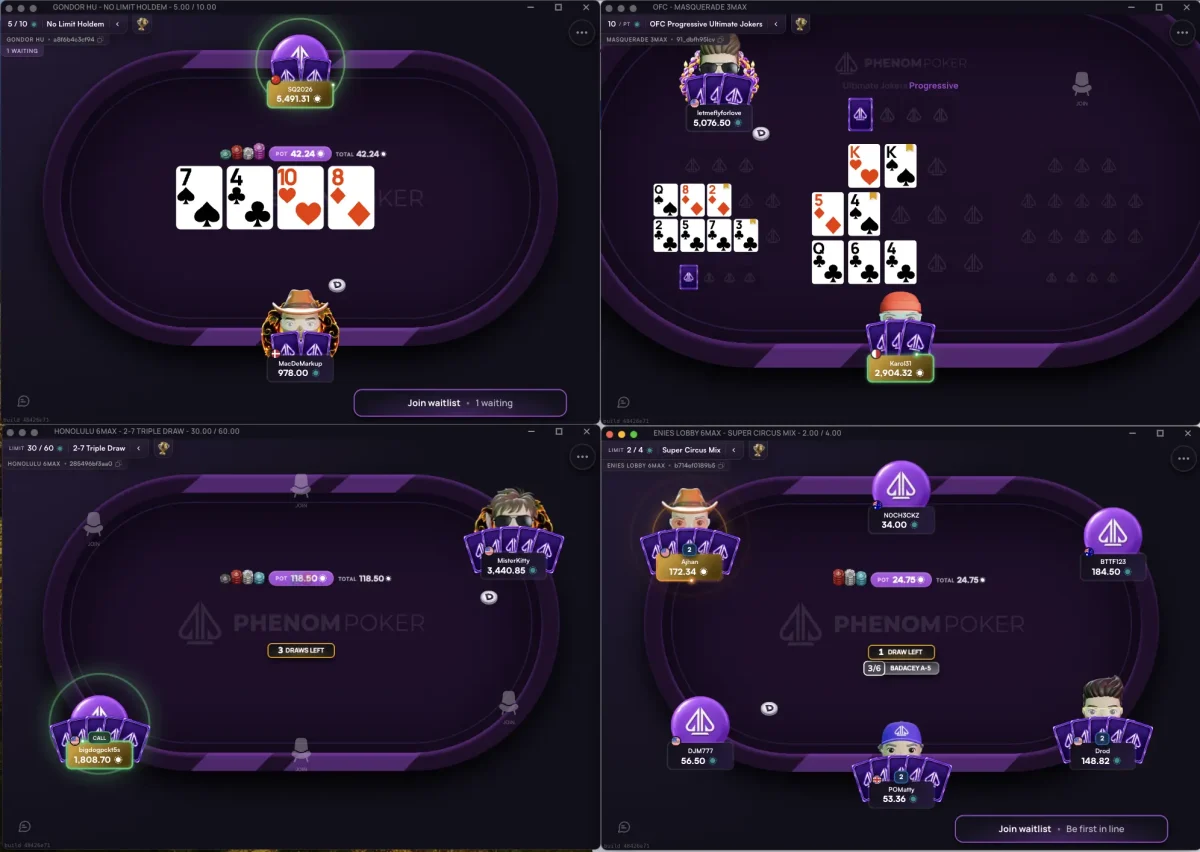
Multi-tabling means you have several online poker tables open during the same session. They can be in the same poker room or several poker rooms. The more poker rooms you have access to, the softer the average game you can find. But, the layout of the tables might get hard to manage!
Beginners should increase the number of tables only gradually, as you can easily lose focus if you add too many tables too soon.
Here’s the terms you might hear thrown around about this topic:
| Term | What it means | Example |
| Multi-tabling | Playing at several poker tables simultaneously | Four cash games running in separate windows next to each other |
| Single-tabling | Playing only one poker table at a time | Someone focusing on one tournament final table to make careful decisions |
| Table layout | How the poker tables are arranged on your display | Six poker windows arranged in a grid to use the display space optimally |
Some poker platforms also feature slots, live games and promotional offers, which can be quite +EV with the right wagering requirements. You’ll often see them in the poker lobby.
Canadian readers can use Slotozilla to compare free spins promotions and review the participating casinos. A player also needs to know how much must be wagered before a withdrawal is allowed and whether a cash-out limit applies – otherwise these otherwise juicy-sounding bonuses might eat into your bankroll! So make sure you check the T&Cs first before activating a bonus.
Advantages and Disadvantages of Multi-Tabling
After raising preflop, you might already be facing a river decision at another table.. With as many as 16 tables open, you might feel like a poker juggler at times and not having enough time to think.
But don’t worry, this is not the usual case. Multitabling has several advantages…
Advantages
- Increased Volume: You’ll see more hands per hour without playing marathon sessions (sick grinders might do BOTH though!)
- Improved Hourly Potential: Extra hands can increase hourly earnings for a player with a positive win-rate. However, a higher hand count will not improve results if weak table selection or frequent mistakes/robotic play cancel out the additional volume. Make sure to not cross over your ‘optimal amount of tables’ once you find that threshold!
- Better Use of Time: Action continues across the other tables if one of the tables breaks up, so you have less idle time waiting for action.
- Getting More Experience, Faster: A larger hand volume requires you to drill the basic spots such as blind defense or button vs BB a lot. . This repetition can help you recognise common patterns more quickly. You’ll need to review the decisions though and preferably run up simulations with a poker solver to get the most out of your play. This is called lab-work in poker!
If you fire up more than 16 or 20 tables, you’re almost guaranteed to time out in some important spots. The advantages only apply when you’re still able to focus on the game at each table. And what happens if you’re not able to do that?
Disadvantages
- Reduced Focus: With 15 games running, it’s easy to lose track of an opponent’s betting habits. By the river, you might remember the action in this hand but have no idea whether your opponent took an aggressive line in the last 5 hands before this one
- Higher Mental Fatigue: Cognitively speaking, playing many tables at once is tiring. You might be able to do it for a few hours, after which you have to pay special attention to your decision quality. Cash games you can quit whenever, but tournaments you just have to keep playing as long as you’re still in!
- More Mistakes: A single missclick can turn an otherwise winning hand into an expensive error. Playing more hands per hour won’t necessarily cover those losses if the misslicks are frequent.
- Lower Decision Quality: Less time per decision, less time to find the optimal play. Quite straightforward!
Common Multi-Tabling Mistakes
Now that you know the advantages and disadvantages, let’s see how to avoid the common mistakes that eat into your win-rate & hourly:
Starting With Too Many Tables
Six tables might seem easy enough at first. Missed raises or expired timers with every 20th hand? Well, they’re a clear sign that the setup needs a change. Try playing 4 tables, or even 3 for a while. Add one more table once the action is smooth and you feel a bit too bored.
Ignoring Table Selection
Players focused on opening as many tables as possible may accept the first available games without carefully checking though the opponents and the position available at the table. Six tables with a meh setup can be less profitable than two amazing tables, even though the volume of hands is only a third in the latter scenario.
Playing on Autopilot
Poker awards players who are able to focus and make good decisions consistently. A third-pot continuation bet might be reasonable on K-7-5 rainbow but less suitable on J-T-9 with two hearts. Before acting, check which bracket the flop belongs to (dry, wet), what the positions are for players in the hand, and what bet-size to use.
Poor Bankroll Management
Let’s say that you’re playing 8 tables with a 100 buy-in bankroll. Now, given a bottom 0.5-1% run, you might just lose +20 buy-ins in a single long session, especially in PLO with deep stacks and aggro opponents. If you’re not prepared to move down immediately after this type of session, you’re better off playing less tables. This gives you time to choose only the softest games available as well as take some space in deciding whether to drop the stakes just a for a while when facing a brutal run of cards.
Which Poker Players Are Famous for Their Multi-Tabling Skills
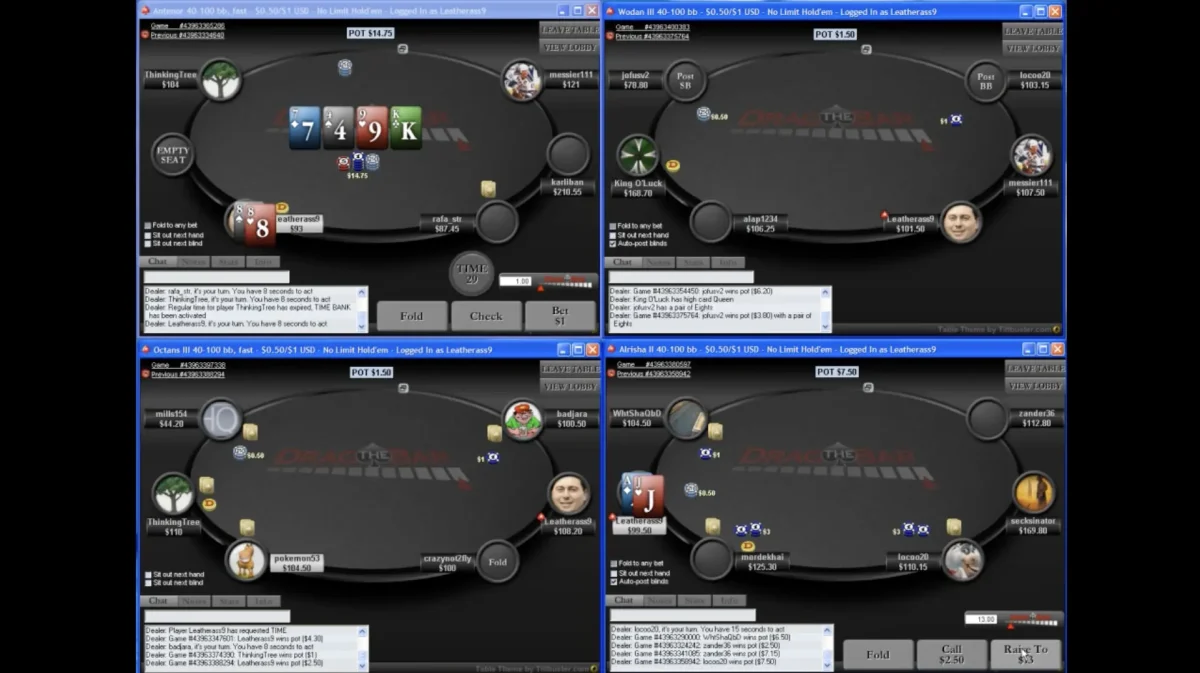
The early days of online poker saw some legends who shaped the concept of multi-tabling and how far one should take it. Here’s a list of notable players who played a massive amount of hands over long hours & often with as many tables as their screens would fit:
| Name | Game formats | Multitasking specialities |
| Isildur1 (Viktor Blom) | High-stakes heads-up and cash games, mainly PLO and NLHE | Ran several heads-up matches at once (up to about 6) in both Holdem and Pot-Limit Omaha, while playing marathon sessions lasting tens of hours. His edge was handling several high-stakes opponents and long sessions at once. When he challenged the top crushers on Full Tilt Poker, he took the Railheaven tables by storm and went on an upswing of several millions playing $200/400 & $300/600. |
| Nanonoko (Randy Lew) | Mainly high-stakes 6-max NLHE cash, later some tournaments | Famous for playing up to 24 cash tables at once. Set a Guinness World Record in May 2012 by grinding 14,548 hands in 8 hours while remaining profitable over this sample, which proves how fast and consistent his decision-making was. |
| LeatherAss (Dusty Schmidt, passed away in 2021) | Mainly NLHE cash games, mid-to-high stakes | A pioneer of extreme table counts in the mid-2000s and one of the first to write about it publicly (you can find the full journey by reading his book ‘Treat Your Poker Like a Business. He approached poker like a disciplined day job, where you need streamlined decision rules, an ergonomic setup, and heavy volume to log millions of hands and capitalize on your edge. |
| Moorman1 (Chris Moorman) | Online MTTs, plus live tournaments | A legend in online tournaments who built a career-record total in MTT cashes. |
Checklist For Successful Multi-Tabling
Pilots have checklists before takeoff. Here’s one for multitabling in poker:
- Build Up Slowly: Add another table only after the action starts to feel smooth, maybe even slow with current table count.
- Limit Interruptions: Keep ANY notifications off and remove anything from the screen (and nearby your poker setup!) that could distract you during a hand.
- Select Games Carefully: Choose juicy tables rather than joining the first available game. Add quantity only after quality!
- Take Breaks: Multitabling (and poker in general) takes up a lot of brainpower, poker being a complex game. Remember to take breaks, and have fresh water and snacks ready to grab.
- Review Key Hands After Sessions: Revisit difficult decisions to play better the next time you sit down at the tables.
- Take Your Alertness Into Account: Poor sleep or a tiring day can leave less attention for poker. There is no need to match the previous session’s table count if you feel 90% instead of 100%.
With these tips, you should be able to start rolling and get your hourly rate up. Good luck at the tables!